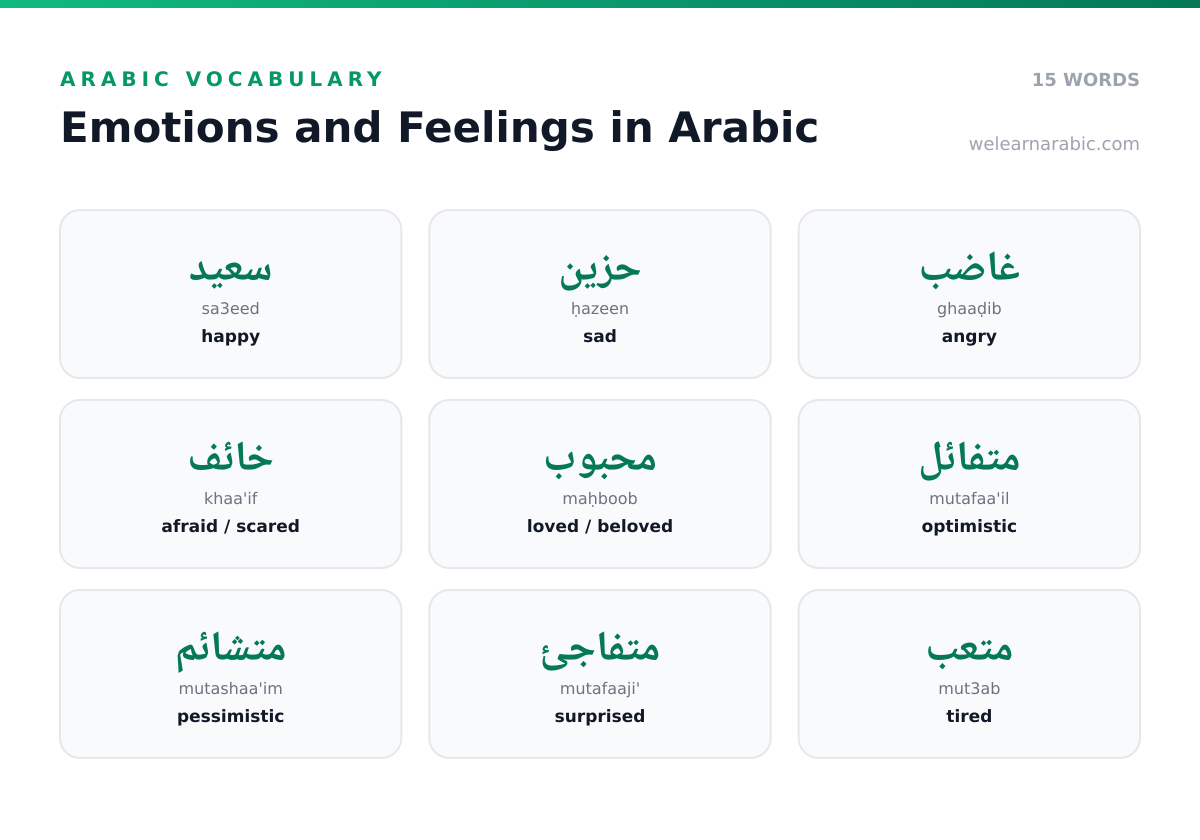
Talking about emotions is essential for meaningful conversation in Arabic. Whether you are writing a diary entry, chatting with friends, or reading Arabic poetry, these words help you express the full range of human feeling. Tap any word above to hear it.
How emotion words are built
Arabic emotion words follow two main patterns:
- The active form describes the person feeling the emotion: سعيد (sa3eed, happy), حزين (ḥazeen, sad), غاضب (ghaaḍib, angry).
- The reflexive form uses the متفاعل (mutafaa3il) pattern, suggesting an emotion that happens to you: متفائل (mutafaa’il, optimistic), متشائم (mutashaa’im, pessimistic), متفاجئ (mutafaaji’, surprised).
Because these are adjectives, they agree with the person’s gender: هو سعيد (he is happy) but هي سعيدة (she is happy).
Emotions in sentences
| Arabic | Transliteration | Meaning |
|---|---|---|
| أنا سعيد بلقائك | ana sa3eed bi-liqaa’ik | I am happy to meet you |
| لا تحزن | laa taḥzan | don’t be sad |
| هو غاضب من الموقف | huwa ghaaḍib min al-mawqif | he is angry about the situation |
| أنا خائف من الظلام | ana khaa’if min aẓ-ẓalaam | I am afraid of the dark |
| هي فخورة بإنجازاتها | hiya fakhoora bi-injaazaatihaa | she is proud of her achievements |
| أنا متحمس للمباراة | ana mutaḥammis lil-mubaaraa | I am excited for the match |
Asking about feelings
| Arabic | Transliteration | Meaning |
|---|---|---|
| كيف حالك؟ | kayfa ḥaaluk? | how are you? |
| أنت سعيد؟ | anta sa3eed? | are you happy? |
| لماذا أنت حزين؟ | limaadhaa anta ḥazeen? | why are you sad? |
| هل أنت خائف؟ | hal anta khaa’if? | are you afraid? |
| ماذا بك؟ | maadhaa bik? | what’s wrong? |
Cultural note
Arabic has one of the richest emotional vocabularies in the world, largely because of its poetic tradition. Classical Arabic poetry (شعر, shi3r) is deeply concerned with expressing emotion — love, longing, pride, and sorrow are its central themes. This literary heritage means everyday speakers have access to a wide range of emotional expression.
Tip: Many emotion words share the متفاعل (mutafaa3il) pattern, which frames the feeling as something that overcomes you rather than something you choose.
Practice
How do you say 'I am happy' in Arabic?
hint: Use 'سعيد' for 'happy'
What is 'حزين' in English?
hint: It is the opposite of 'happy'
How do you ask 'are you angry?' in Arabic?
hint: Use 'غاضب' for 'angry'
Share what you know
0 notes from learners — add an example, a tip, or a correction
Know something that would help?
Add an example, a tip, or a correction for other learners.
Sign in to contribute