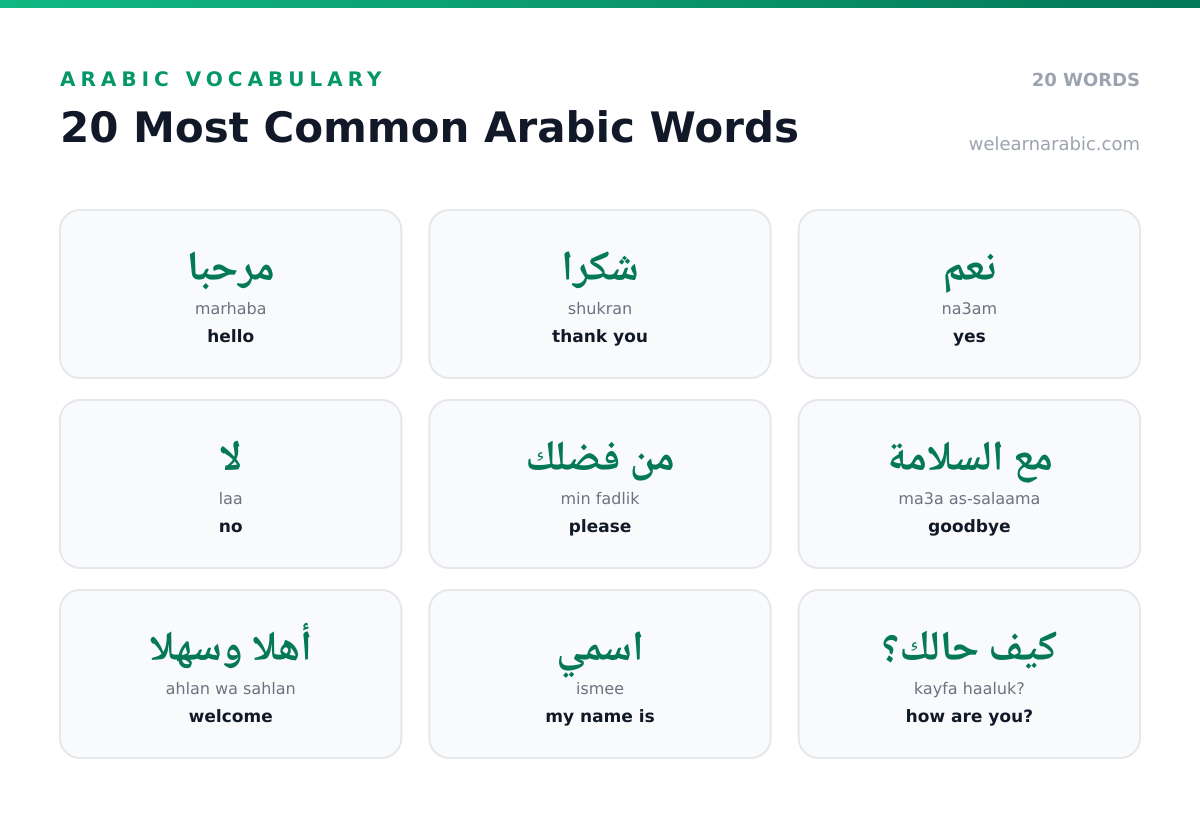
These 20 words form the backbone of everyday Arabic. Learn them first and you can handle greetings, polite requests, and the nouns that come up in almost every conversation. Tap any word in the list above to hear it pronounced.
Polite expressions in context
Politeness is central to Arabic conversation. شكرا (shukran) means “thank you,” and the standard reply is العفو (al-3afw, “you’re welcome”). Use من فضلك (min fadlik) when asking for something, and أهلا وسهلا (ahlan wa sahlan) as the warm, full version of “welcome.”
| Arabic | Transliteration | Meaning |
|---|---|---|
| شكرا جزيلا | shukran jazeelan | thank you very much |
| العفو | al-3afw | you’re welcome |
| من فضلك، أين الباب؟ | min fadlik, ayna al-baab? | please, where is the door? |
| ماء، من فضلك | maa’, min fadlik | water, please |
| اسمي سارة. تشرفنا | ismee Saara. tasharrafnaa | my name is Sarah. nice to meet you |
Everyday nouns
Many of these words share productive roots. كتاب (kitaab, book) comes from the root k-t-b, which also gives كاتب (kaatib, writer), مكتبة (maktaba, library), and كتابة (kitaaba, writing). Likewise مفتاح (miftaah, key) comes from the root f-t-ḥ, the same root as فتح (fataḥa, to open).
| Arabic | Transliteration | Meaning |
|---|---|---|
| عندي كتاب جديد | 3indee kitaab jadeed | I have a new book |
| المفتاح على الطاولة | al-miftaah 3ala aṭ-ṭaawila | the key is on the table |
| الوقت متسع | al-waqt mutasa3 | there is plenty of time |
| يوم حلو | yawm ḥilw | a beautiful day |
| بيت كبير | bayt kabeer | a big house |
Food and drink
Offering food and drink is a cornerstone of Arab hospitality. If you visit someone’s home, expect to be offered شاي (shaay, tea) or قهوة (qahwa, coffee) — accepting is a friendly gesture. Note that “café” (the place) is مقهى (maqha), while قهوة is the drink itself.
Cultural note
The phrase الحمد لله (al-ḥamdu lillaah, “praise God”) is the standard reply to “how are you?” and signals that all is well. It is used by Arabic speakers of all backgrounds as a humble, everyday expression. Similarly, إن شاء الله (inshaa’ Allaah, “God willing”) is added whenever talking about the future.
Practice
How do you say 'thank you' in Arabic?
hint: It is one of the most common words you will hear
What does 'من فضلك' mean?
hint: Literally 'from your favor'
How do you say 'I have a new book' in Arabic?
hint: Use 'عندي' for 'I have'
Match each pair — start with Arabic (left)
0 / 8Arabic
English
← Select an Arabic word, then tap its meaning →
Ready to greet people properly? Continue to Greetings and Polite Phrases.
Share what you know
0 notes from learners — add an example, a tip, or a correction
Know something that would help?
Add an example, a tip, or a correction for other learners.
Sign in to contribute